More Korean History
It's Sunday and I'm at Chilwon Elementary. Thankfully the live-in janitor heard me knocking and let me in; otherwise I would have to either wait till tomorrow or visit the :"PC Bang" On my way here today I thought I'd take some photos of my neighbourhood. Here they are in order as I came across them while walking here...
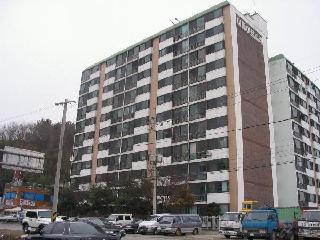
Deh Ryung Apartment Building
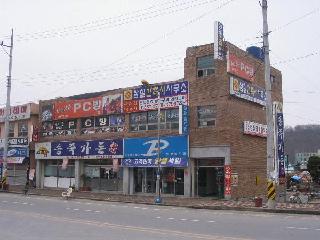
The Infamous PC Bang
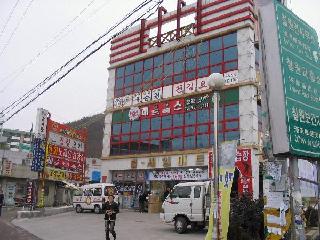
The Whole Sale Mart
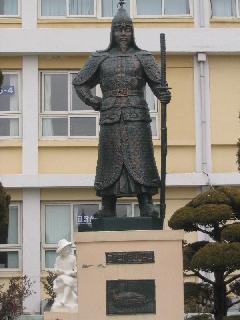
Statue
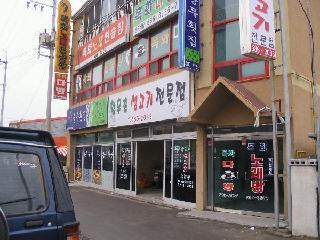
My Favourite Restaurant
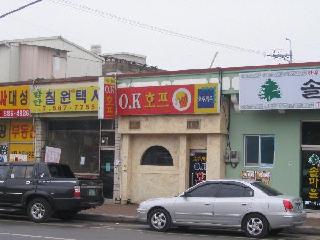
Bar
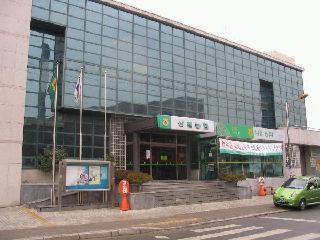
The Bank
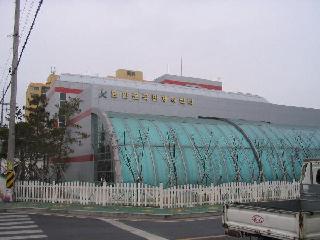
The Pool
As I sit here typing this I can't help but think about the fine statue (see picture) of a famous and really rather imposing general or king that stands guard over the occupants of the school. I can see the statue from this 1st floor office. If he really lived, he must have been quite a fearsome fella. Not someone you'd want to slip a "whoopie cushion" under. Speaking of Korean history....this past weekend I went to Masan again with my co-teacher to see a movie. I thought it only fair that this time we see a Korean film, so I picked one that looked interesting, and it was. Very different! A classical story from Korea's very ancient past. Here's a very brief summary of Korean history that I found on the web....
[i]The history of human activity in Korea can be traced far into the Paleolithic period, about 500,000 years ago. The beginning of Korean history is often dated to 2333 B.C. when King Tan-gun, a legendary figure born of the son of Heaven and a woman from a bear-totem tribe, established the first kingdom named Choson, literally meaning the "Land of the Morning Calm." While the historicity of the Tan-gun myth is disputed among scholars, it is known that ancient Korea was characterized by clan communities which combined to form small town-states. They rose and fell so that by the first century B.C., Three Kingdoms, Koguryo (37 B.C. - A.D. 688), Paekche (18 B.C. - A.D. 660) and Shilla (57 B.C. - A.D. 935), had emerged on the Korean Peninsula and part of what is now known as Manchuria.
Ever since Shilla unified the peninsula in 668, Korea has been ruled by a single government and has maintained its political independence and cultural and ethnic identity in spite of frequent foreign invasions. Both Koryo (918-1392) and Choson (1392-1910) Dynasties consolidated their dynastic power and flourished culturally, while repelling intruders like the Khitans, Mongols, Manchus or Japanese.
In the late 19th century, Korea became the focus of intense competition among imperialist nations such as China, Russia or Japan. In 1910, Japan annexed Korea and instituted colonial rule, bringing the Choson Dynasty to an end and with it traditional Korea. National liberation occurred in 1945 but was soon followed by territorial division. The Republic of Korea in the South has a democratic government, while the Democratic People's Republic of Korea in the North is ruled by a Communist regime.
And that's the way it is.
This is the last week of English Camp. That was fun! It was a great experience and what I learned will no doubt help me to be a better teacher when regular classes begin again on February 1. I'll be off on winter vacation from January 21-31. I'm going to see about perhaps taking a little trip somewhere else on the peninsula...perhaps I'll spend a weekend in Seoul or Busan. I'd also like to finally get together with the 3 other ESL teachers in the Haman School District.
I'll spend quite a lot of my winter vacation planning lessons. I want to have at least a month's worth of lessons planned so I can be ahead of the eight ball for a change. It'll be nice to know what I'm going to do and how I'm going to do it before I walk in to class. I don't know that many card or coin tricks and one can only get so far by wiggling one's ears. But, isn't that true of life in general. Wow! That philosophy degree really wasn't a waste of time after all.
After winter vacation I'll be teaching at a different school each day of the week. I think I'll be at good ole' Chilwon Elementary on Mondays, but other than that I don't know. Someone will come to my apartment and take me to the other schools, none of which is nearby.
Well, time to take some more pictures, then hit the water for some laps. I'm hoping that by spring I'll have lost enough weight that I'll be able to buy some nice clothes here. I really didn't bring enough to wear from Canada.
I'll finish this blog entry tomorrow.
It's Tuesday, January 17. I didn't have a chance to work on the blog yesterday.
The everyday Korean expression for "hello" and "goodbye" in Korean is "Anyong-Hasay-o". It's a wonderful expression very much like the Hawaiian, "Aloha". It literally means "Be in peace". There are variations for either when one leaves a room that means "Stay in peace" and for bidding farewell to someone who's leaving, "Go in peace".
P.S. The postcard thing? I took the 9 postcards that all had come back to me to the post-office and it was obvious to the postman what had happened. Even though the stamps had all been cancelled, he very kindly resent them for me.
|

