China Day 3: August 24
As usual we headed out right after breakfast at about 7:30am. This would be another very full day. First, we went to a traditional Chinese clinic where I sat in front of a doctor who held both my wrists and looked into my eyes to determine the state of my Chi. As I understand it, the whole point of Chinese medicine is to promote the free flow of Chi throughout the body. It certainly doesn't take a doctor to tell me that my body runs pretty hot. The doctor said this was the case because I have a fat liver and my Chi isn't flowing freely because of it. He said the problem isn't very serious and prescribed an herbal tea which cost me $80 for a 3 month supply. He said the tea would also promote weight loss. Why not?
The next stop on our itinerary was "The Summer Palace". The original "Summer Palace" was built by The Qing-Dynasty Emperor Qianlong ( Ruled 1736AD - 1796AD). It is located North-West of Beijing and served as the Emperors' Summer Retreat. This first "Summer Palace" enclosed a multitude of buildings and a very large Garden known in chinese as the Yuanmingyuan or Garden of Perfect Purity.
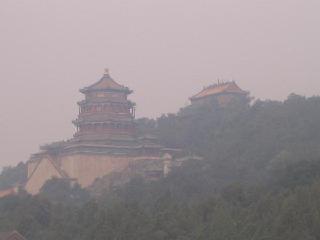
Summer palace
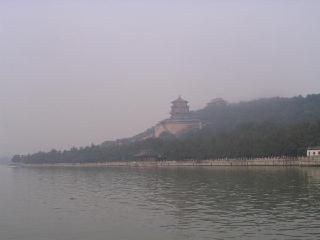
Lake and summer palace
Friends
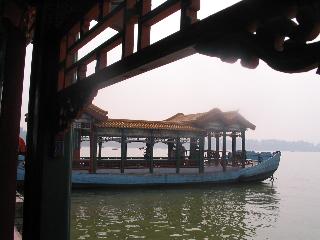
The kind of boat we rode around the lake
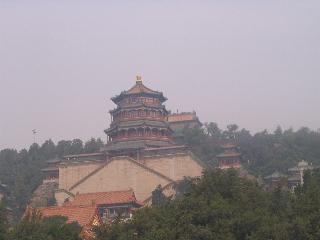
Summer palace from the lake
After lunch we went for a tour of a silk factory. The Korean guide had arranged for me to have a private tour with a guide who spoke English. It was fascinating to learn about how silk is made. So much work! So many poor silkworms! I saw all the stages of the silkworms which lives for only 45 days. Silk of course comes from the cocoons that they weave around themselves while they morph into moths. The cocoons with the larvae inside are first soaked in hot water to soften them and then a worker skillfully grasps a single strand and winds it on a spindle. 1 strand alone doesn't have enough strength, so the strands from 8 cocoons are wound together to form a single silk thread. The silkworms inside die of course, but they are not wasted. They are used for cosmetics and sometimes roasted and eaten.
I couldn't help myself and bought a beautiful silk quilt with an even more beautiful silk cover. There is no way this could be bought anywhere for less. It only cost about $150. I'm sure the same thing would cost five times more in Canada. The quilt and cover together required many hours of work and the lives of over 100,000 silkworms.
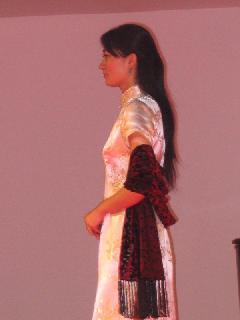
Beautiful runway model at the silk factory (Beijing Tianhou Silk Co. Ltd.)
Before leaving the silk factory we were treated to a fashion show. Then, we went to a theatre and watched a martial arts show. It was a stage production about the history of Kung Fu.
The absolute highlight of this day was our tour of the Forbidden City and Tiananmen Square. The Forbidden City, also called the Palace Museum, the Purple Forbidden City or Gugong Museum in Chinese, is located in the center of Beijing, China. The Forbidden City was built between 1406 and 1420 during the Ming Dynasty. It had been the imperial home of 24 emperors of the Ming (1368-1644) and Qing (1644-1911) dynasties. From their throne in the Forbidden City, they governed the country by holding court sessions with their ministers, issuing imperial edicts and initiating military expeditions. For 500 years common people were not allowed to enter the city, hence its name.
After the republican revolution in 1911, the youngest and last emperor of the Qing Dynasty, then still a child, abdicated the next year. But he, his family and their entire entourage were allowed to stay in the palaces. They were finally expelled by republican troops in 1924. This was the basis for the movie "The Last Emperor" which was filmed here.
The "Forbidden City" has been known to the public as the Palace Museum since 1950. It is one of the largest and best-preserved palace complexes in the world. There are over a million rare and valuable objects in the Museum. The Imperial Palace Grounds are located directly to the north of Tiananmen Square and are accessible from the square via Tiananmen Gate. It is surrounded by a large area called the Imperial City.
Although no longer occupied by royalty, the Forbidden City remains a symbol of Chinese sovereignty and the image of Tiananmen, the entrance to the Imperial City, appears on the seal of the People's Republic of China. The Palace Museum is now one of the most popular tourist attractions in the world. Recently, the site has been under much renovation which has limited visitors to the main courtyards and a few gardens.
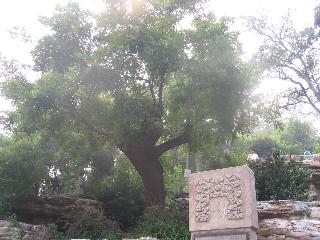
Scholar tree where last Ming emperor hanged himself in 1644
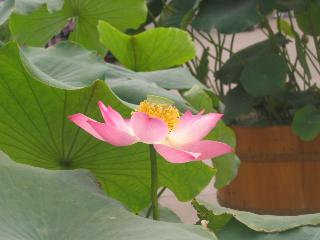
Lotus Flower
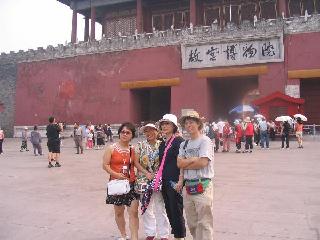
Maria, Lisa, Stephanie and James
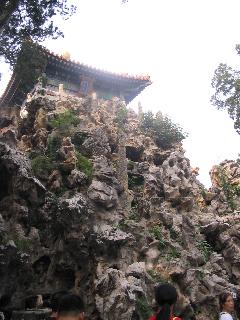
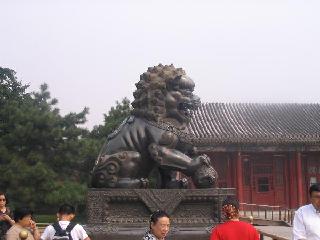
Imperial Lion bedroom guard. This is a sign of power. The right paw of the male lion is usually raised and the lion has a pomegranate, also a sign of power.
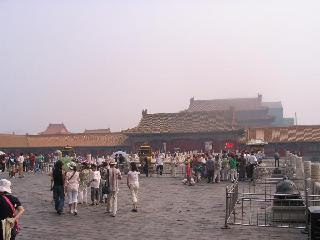
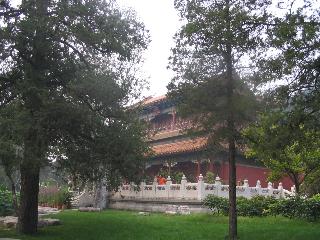
Forbidden City (Palace Museum)
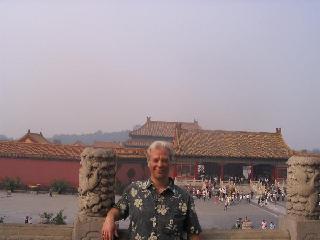
In the Forbidden City.
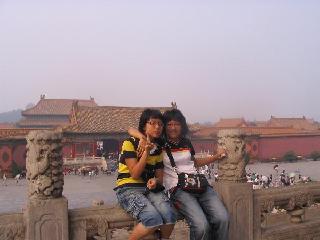
Friends
We exited the Forbidden City through the North Gate and found ourselves in Tiananmen Square. As I looked behind me after coming through the gate there was that famous picture of Mao Tse Tung on the wall over the entrance. This was another one of those 'pinch me' moments.
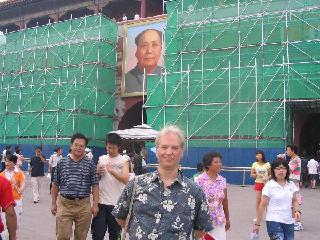
Mao and me
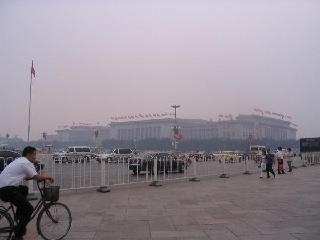
Tiananmen Square
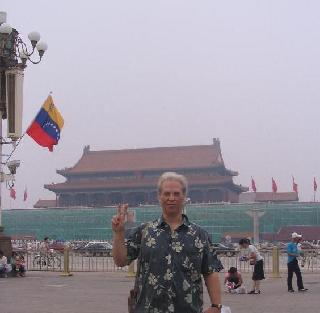
The usual spot where just about every Chinese person has their picture taken at some point
We walked through the square for a while to meet our bus. Then, we went for supper. After returning to the hotel I really wanted to scratch the itch I had for a couple of "Coronas", so I went to the hotel bar. I chatted for a while with a man from Florida. After the man and his friends left I was the only customer in the bar, so I challenged the bartender to a game of pool. We ended up playing three games; he won them all.
Time for bed.
|

